Sustainable Livelihoods
What a savings group knows about risk
Ninety-six groups in the Chansolo Basin have been managing agricultural risk for a generation. What they lacked was a building.
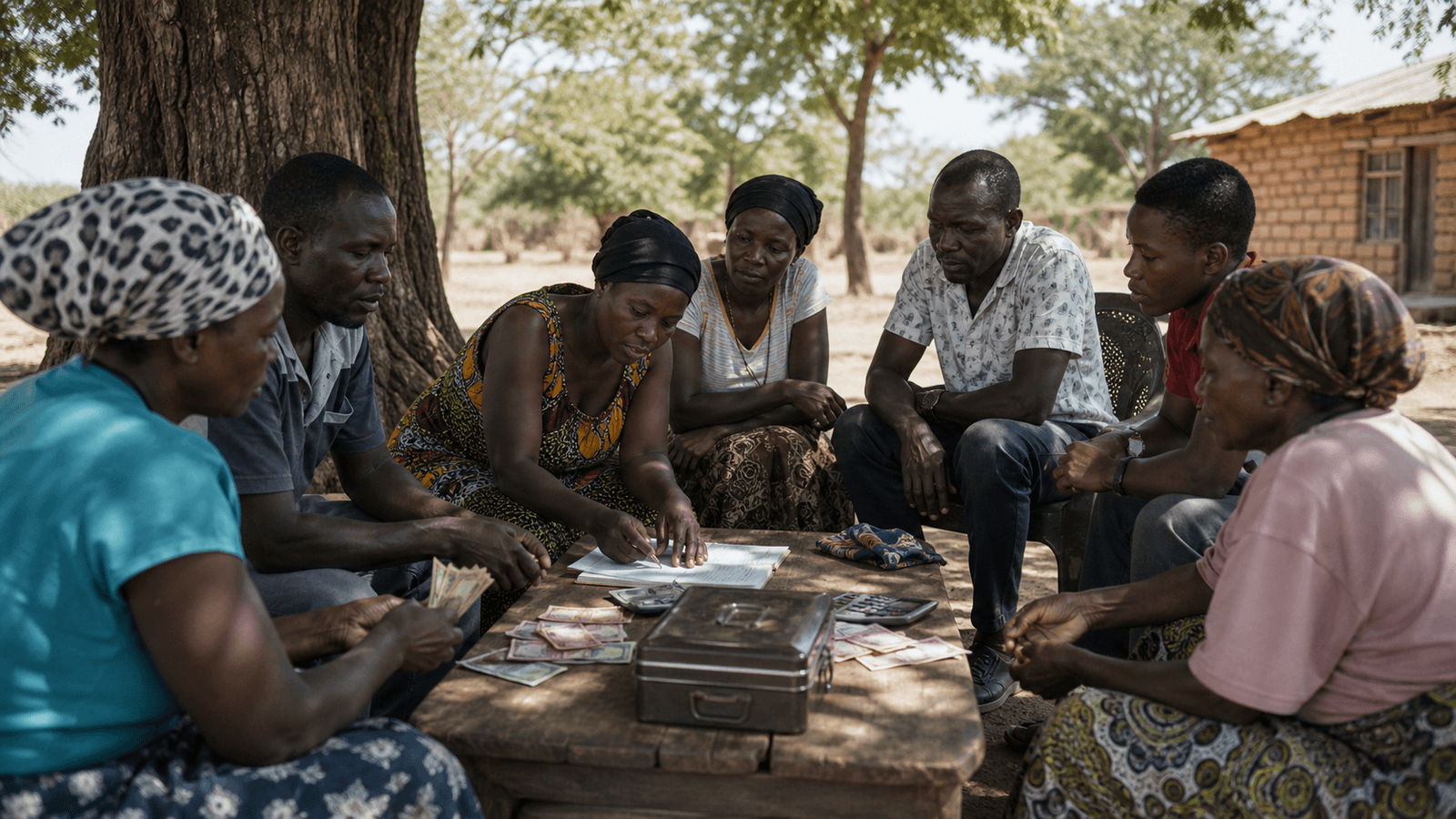
In the development sector, a great deal of money is spent teaching rural households to save. I have sat in a number of those workshops. In every one, at least one person in the room was already the treasurer of a group that had been saving, lending, and recovering money for longer than the organisation running the workshop had existed.
The Chansolo Savings Federation was founded in 2003. By the time it approached Fieldstone in 2014 it had eleven member groups, a written constitution, an interest rate its members had set and twice revised, and a default rate under two per cent. It had never received a grant.
The question they actually asked
The federation's letter was short and specific. It did not ask for capital. It asked whether Fieldstone would fund two buildings and a set of certified scales.
Groundnuts in the basin are harvested in April and May. Everyone harvests at once, everyone sells at once, and the gate price in those six weeks is roughly two-fifths of what the same crop fetches in February. Every household in Chansolo understood this arithmetic perfectly. None of them could act on it, because acting on it requires being able to not sell for nine months, and that requires somewhere to put the crop that is dry, secure, and not your kitchen.
We did not need to be taught about the price. We needed a roof, and a weight that nobody could argue with.
Four years of rules
The buildings took eleven months. The rules took four years, and they are the part of this that transferred to other regions.
- Who may store, and what happens to a member who joins in a bad year.
- The storage fee, and whether it is charged per bag or per month.
- What recourse a member has if the store fails — and who insures against a leak.
- Whether the federation may lend against stored crop, and at what proportion of its value.
- What happens when a member needs cash in June and their groundnuts are locked in until February.
The last of those is the one that nearly ended the arrangement in its second year. The federation's answer — a bridging advance at 60% of the February price, repayable from the sale, capped at a third of the store's holdings in any season — was drafted, rejected, redrafted, and passed by member vote in 2017. Fieldstone advised against the cap being that low. The federation was right and we were wrong.
Nine stores, seven of them theirs
Fieldstone paid for two buildings. The federation has since built seven more from its own reserves, and holds €2.1 million in member funds that we neither control nor have any visibility of beyond what is published in its own accounts. Ninety-one per cent of its operating costs are now met from member fees.